
Escaping the novelty trap
Appropriability and the case for open-by-default agricultural R&D
Co-authored with Guy Coleman (Noktura; University of Copenhagen)
Published in the Australian Farm Institute's Farm Policy Journal - October 2026
KEY CONCEPT: the assumption that new automatically means capturable value, and that value capturable by the originator is the same thing as valuable to the sector.
Abstract
Australia’s national research and development (R&D) intensity has declined sharply to 1.69% of GDP, falling well behind the OECD average of 2.7%. Concurrently, Australia’s rural research and development corporations (RDCs) and university technology transfer offices face mounting pressure to demonstrate tangible on-farm impact. This paper argues that the commercialisation of Australian agricultural innovation is hobbled by a fundamental conceptual error: a ‘novelty trap’ that assumes technical novelty automatically translates into capturable commercial value.
Drawing on David Teece’s framework on profiting from innovation, we separate the innovation pipeline into three distinct stages: (1) value identification (inventing a technical solution), (2) value creation (delivering real-world benefits on farm), and (3) value capture (building sustainable business models).
Australian research bodies currently treat all three stages as equivalent, assuming that every new discovery can be locked behind strict intellectual property (IP) protection and spun out into exclusive, equity-heavy companies. In reality, most digital and agricultural technologies – such as camera-based weed detection, platforms, algorithms, sensors and data tools – are easy to replicate and hard to fence off. Attempting to protect them with aggressive equity demands (up to 40% at Australian universities compared to about 6% in the US) creates administrative friction that constricts adoption and downstream innovation.
To fix this, we advocate for an open-by-default investment strategy for publicly funded research. By open-sourcing baseline code and datasets, standardising university spinout terms and focusing on business models that may be better suited to Australia’s small, niche markets, Australia can accelerate technology diffusion across its diverse agricultural space. Over the next decade, reforming how we commercialise research through institutional innovation may prove far more consequential than inventing new tools.
Introduction: The novelty trap
Inventing something valuable and profiting from it are inherently different things, yet often conflated. Teece centred his 1986 paper ‘Profiting from technological innovation: Implications for integration, collaboration, licensing and public policy’ on this point specifically, and it has remained valid in the decades since. What determines whether an innovator profits is the ability of the inventor or innovator to capture and fence off the value surrounding both the invention and the complementary assets available to support it. Teece termed this ‘strong appropriability’. Said another way, value created and value captured are separate quantities, and they do not necessarily accrue to the same party. Understanding the conditions that determine the strength of appropriability is critical.
Australian research commercialisation is largely built on the assumption of strong appropriability as a general condition. The prevailing transfer model treats the path from research to market as a fairly linear transfer:
- develop something novel
- build a startup around the intellectual property (IP)
- take equity in the company
- let the company deliver the product
For parts of agtech, the strong appropriability assumption is valid, but for others it is not just unsound, but detrimental to downstream innovation. Many weed detection models, climate prediction models, sensing and data-layer tools are weakly appropriable, particularly within the current framework of large language model (LLM) performance and usage. This isn’t to say they are useless, but simply that LLMs and the open-source community can very quickly and effectively replicate much of what was once considered a moat. Instead, the value they create leaks to complementary assets, or it fails in delivery through sub-economic conditions. Growth in LLM performance and usage will only continue to erode the appropriability of these tools.
This linear approach from research to market fails to consider who the research was for. The confusion is a familiar one in agtech, where founders routinely mistake the user of a product for its beneficiary. Australian agricultural research is funded by levy payers and taxpayers. Farmers are not the end customer at the far end of a commercialisation pipeline; they are the primary intended beneficiary, and they have already paid through levies. The measure of success is whether the benefit reaches farmers at scale and delivers the stated effects.
Diffusion is therefore the objective. Farmers benefit when an innovation reaches the greatest number of them, and when they can capture the value it identifies at the farm gate. Diffusion, not equity, is the mechanism by which public investment returns value to the public that funded it.
The current system has substituted a proxy for the goal. Equity stakes, licensing revenue and tight IP positions look like value capture and are easy to measure within the confines of ‘return on investment’; however, they measure the wrong party’s return, and they frequently work against the organic diffusion of technology. Restrictions that improve the originator and funding agency’s capture position reduce the pathways via which benefit can reach the beneficiaries of the work.
This is the novelty trap: the assumption that new automatically means capturable, and that capturable by the originator is the same thing as valuable to the sector.
Australian research and development (R&D) intensity sits at 1.69% of GDP against an OECD average of 2.7%, down from around 2.25% in 2008–09 (ABS, 2025; OECD, 2025). With less to invest, the efficiency with which investment converts into on-farm impact matters more. Yet the terms on which Australian institutions release research into companies sit well outside the range of comparable systems, with equity stakes several times those taken by US and European universities and no national standard to constrain them.
This paper sets out a three-layer value system – value identification, value creation, value capture – as three separable problems requiring different treatment. It examines what changes when they are treated separately, and argues for an open-by-default posture for levy- and taxpayer-funded research. The current system bets heavily that innovations improving on-farm profitability will come from highly valuable technological innovations, constraining the potential impact of institutional and business model innovation in the process.
A three-layer value system
The incumbent approach conflates the vehicle that delivers an innovation with the system that benefits from it. Because the two are treated as one, decisions taken at the point of initial commercialisation hamstring the delivery of impact at a system level. The assumption that a single entity can always carry an innovation through all three phases is flawed, or at least ill-suited to the circumstances of Australian agriculture.
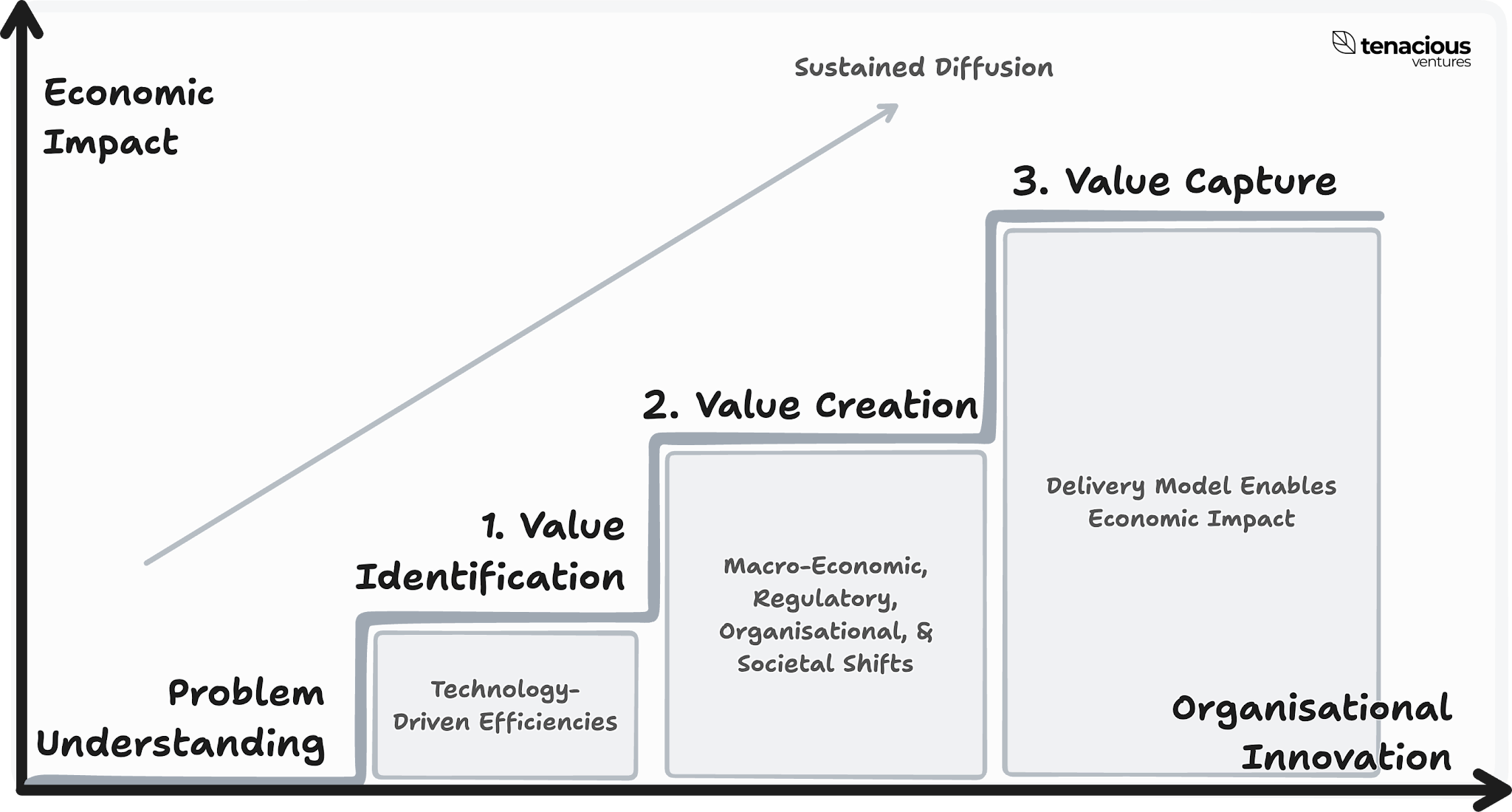
Figure 1. A Three Phase Value System
Figure 1 outlines a three-phase value system, that we've previously discussed, where each phase is governed by a different force: identification by technology-driven efficiencies, creation by macro-economic, regulatory, organisational and societal conditions, and capture by delivery model design.
Phase 1 – value identification
Origination: the novel process, the technical insight, the identification of an inefficiency and a pathway to address it. This is what the Australian research system is organised around, and on its own terms it does so reasonably well. We often point to deeptech innovations like Wi-Fi, cochlear implants and spray-on skin as evidence of this system succeeding.
Yet, the fundamental challenge with this phase of the value system in agtech is that it becomes loaded with unrealistic expectations in its value and appropriability, which may preclude future benefits from materialising. Identification is often treated as the hardest part of the process and therefore tightly appropriable by default (each discovery has a tall barbed-wire fence around it, or a deep moat, depending on your metaphor of choice), with everything downstream assumed to follow from it. And, technically and scientifically, it is the most difficult, often relying on significant investment, deep research, years of work and world-leading understanding of a particular topic.
Australian universities and research partners take very high equity stakes in companies built on their research, with no standardised national approach to spinning one such company out. The variance across institutions is extreme. The University of Queensland, through UniQuest, generally does not allow founders to hold equity at all, stating explicitly that ‘start-up companies used by UniQuest to commercialise UQ IP typically do not involve researchers as shareholders’ (University of Queensland, 2022). Institutions like QUT may demand up to 40% equity, though specifics of each deal are kept under wraps (Moore, 2024). Global data from the Spinout.fyi database (covering 143 spinouts across 71 institutions) puts the average US university equity stake at 5.9%, the European average at 7.3%, and the UK average at 19.8% (spinout.fyi, 2022).
In contrast to Australia’s fragmented approach, Denmark has adopted a standardised spinout contract across its eight universities and agreed to by the main business and industry partners, to eliminate negotiation gridlock (University of Copenhagen, 2026). The default is a royalty on net sales within published bands of 1 to 6%, set by a shared calculation tool. Equity exists only as an option the founder can propose to offset royalty rates and is capped at 5%. Besides royalties, founders can instead fix a buyout price at signing, with windfall payments returning value to the university if the company is later sold or grows past DKK250 million in turnover (Danish Universities, 2025). A clear advantage is that decisions are streamlined to weeks rather than months or years, and the licence will lapse if the spinout does not actively develop the invention, on the stated principle that publicly funded research must ultimately benefit society.
Nevertheless, decisions that constrain how an innovation will reach a farm are made here, at the point of least information about delivery. Unfortunately, by the time delivery (through some business model, startup or otherwise) becomes the reality, the how has already been decided through equity and licensing arrangements. This constrains the future value of the idea in ways that are hard to unwind, often preventing beneficiaries of the work from harvesting the promised gains.
Phase 2 – value creation
Value creation represents the transition from technical possibility to real-world utility – in other words, the ‘valley of death’: a place where value is generated or lost entirely. Current practice mistakenly prioritises appropriability (fencing off value) in Phase 2. In reality, value creation depends entirely on technology diffusion – the rate and scale of adoption across farms. Every institutional barrier that makes technology harder to access directly reduces the delivered benefit that justified the public investment.
Value creation is contextual, not intrinsic to the tool. For example, consider in-crop or green-on-green weed detection systems for site-specific weed control. The camera hardware and vision algorithms represent Phase 1 technical capability. However, the economic value created (Phase 2) is dictated by external variables. In this example, we’ll take high-value and zero-value creation scenarios:
- High-value creation: When herbicides are expensive, weeds have developed chemical resistance and off-target drift carries heavy fines, an artificial intelligence (AI) camera reducing chemical inputs by 70% creates thousands of dollars per hectare in real savings.
- Low-value creation: If herbicides were low cost, abundant and without accountability for any environmental or health risk, the exact same camera and AI model would create minimal economic value, regardless of its technical sophistication.
Note we have not implied that any value created is captured. Just because value is created does not prima facie ensure it can be captured. Scenario 1 above may allow for an innovator or service provider to charge for the service, allow the farmer to reduce costs and increase profits, or enable downstream actors to demand lower prices.
Furthermore, much of the value created in agriculture takes the form of non-excludable public goods, such as landscape-wide herbicide resistance management, environmental chemical reduction and biosecurity surveillance. Proprietary business models struggle to capture the value of public goods because individual market actors cannot privatise spillover benefits.
Crucially, individual startups face coordination failures in challenging large-scale environments and lack the balance-sheet capacity to build shared, non-excludable preconditions that facilitate further development – assets like open datasets, machine-readable regulations, interoperable software ontologies and empirical regulatory safety evidence. Because these requirements are systemic public goods, Phase 2 is where public research and development corporation (RDC) intervention has the highest leverage, yet it is where public capital is least frequently applied.
Developing an open-by-default approach here resolves this bottleneck, particularly in the context of Australia’s long tail of small and niche markets that are not on the radar of larger companies. Providing a shared ‘base recipe’ allows local developers and agronomists to adapt baseline tools for regional contexts without rebuilding core infrastructure, lowering the cost of turning ideas into created value.
Phase 3 – value capture
Central to value capture is understanding the conditions that must exist for benefit to reach the farm gate, and for the farmer to capture the widest possible share of that created value.
Traditional commercial strategy views value capture from the perspective of the company, defined by the margin the originator retains through service delivery. In publicly funded agricultural R&D, the party whose capture matters most is the primary producer. Startup or company-level profit capture is certainly an important vehicle to maintain distribution, field support and ongoing service, yet shouldn’t be the primary goal of public policy.
Value capture does not happen at the point of invention (Phase 1). Instead, it relies on the complementary assets surrounding a technology, such as distribution networks, local machinery integration, agronomic field advice, trust and operational telemetry (Teece, 1986). In digital agtech, almost all software, algorithms and sensors operate in a weak appropriability regime (easy to replicate, hard to fence off). Generative AI through LLMs and open-source development of high-performing vision models have reduced code replication costs dramatically, while vision sensors and hardware components continue to commoditise.
Privatising weak appropriability assets is counterproductive particularly from the perspective of the farmer, so we propose three practical mechanisms as an alternative and use case studies following to demonstrate their benefits:
- The open-core model: As Appleyard and Chesbrough (2017) show, open sourcing the foundational software layer expands the total addressable market. Commercial providers then capture sustainable margins on assets that can be owned.
- Collective and cooperative ownership: Where the benefit of a digital asset is shared across a sector, the institutional owner should be producers collectively. This follows historical precedents like farmer-owned irrigation trusts and contemporary digital platforms like Dutch JoinData.
- Mandatory interoperability and founder mobility: Requiring open application programming interfaces (APIs) allows new digital tools to integrate directly with existing machinery on farm.
The operational role of RDCs
The structural friction in agtech stems from RDCs treating all three phases as commingled, encumbering early inventions with significant commercial constraints. Traversing the value creation and capture phases depends on macroeconomic and structural conditions – preconditions that are prohibitively expensive for individual startups to resolve alone, but that RDCs are uniquely positioned to address.
The role of an RDC is not to hand early-stage IP to a commercial spinout and expect the market to solve systemic bottlenecks unaided. Instead, the RDC’s primary mandate should be to:
- co-create the infrastructure that establishes the preconditions for crossing the valley of death;
- catalyse the establishment of regulatory certainty where current ambiguity acts as a binding constraint on adoption;
- act directly on structural bottlenecks, by building open, non-excludable assets that help improve the innovation potential for all.
Openness exerts a dual effect: open assets establish the essential preconditions for technology diffusion, while deliberately reducing the drag of artificial legal fencing. What the agricultural R&D system must optimise for is delivered economic benefit to Australian primary producers. The operational role of an RDC shifts from being primarily an equity-holder in commercialisation vehicles to a builder (and operator) of the complementary assets and structural conditions under which many commercial vehicles can succeed.
Case study: AI as standard infrastructure
AI models in agriculture are only as reliable as the underlying digital infrastructure that feeds them. When foundation models, agronomic datasets and domain ontologies are treated as closed, proprietary IP rather than shared public infrastructure, the economic returns on publicly funded research fail to compound across the sector.
Data and AI sovereignty
Australia faces an acute data sovereignty threat, because the country possesses almost no open, structured agricultural datasets nor foundational AI infrastructure. International benchmarking initiatives such as AI AgriBench establish global performance standards for agricultural AI, yet Australian growing conditions, soil profiles and climate realities are largely absent from these benchmarks. This exclusion is not deliberate; it occurs simply because Australia lacks open datasets available for international inclusion.
Other nations treat public research data as a strategic national asset that is more powerful when shared. Under the US Department of Agriculture (USDA) Public Access Directive, any researcher receiving USDA funding is legally mandated to publish their underlying data to the Ag Data Commons, a public repository managed by the National Agricultural Library designed explicitly for discoverability and long-term reuse (USDA National Agricultural Library, n.d.). The obligation attaches directly to the research funding itself. Australia has no equivalent national requirement, leaving its agricultural sector structurally dependent on foreign-trained algorithms.
Open ontologies
Pavement, sidewalk or footpath? Sowthistle, milk thistle or milk tassel? The same thing goes by different names depending on where you are – a problem that formal ontologies seek to address. From the perspective of an LLM, structured ontologies allow a model to guide its own next token predictions by referencing contextual information. From a standardisation perspective, ontologies have always been important, but historically delivered impact slowly and in long form. Paired with LLMs they matter far more, because they close the gap between model ‘hallucinations’ and genuinely useful outputs on niche datasets and questions. In August 2026 a farmer in Anhui, China, sprayed a tank mix recommended by an LLM across 10 hectares of sesame, losing the seedlings overnight (Cuthbertson, 2026). The mix reportedly included a soybean herbicide that sesame does not tolerate. Agricultural chemical label databases are in effect an existing and highly valuable ontology for agronomy, with key information on crop, weed and environmental interactions with various chemical rates relatively standardised across the globe, presented in a structured and consistent manner. Unfortunately, these labels are largely machine inaccessible and in a form that is rigid for good reasons but underexploited.
The obvious objection to ontologies and more standards is proliferation. The risk of unifying standards is that you have simply added one more to the pile of unused standards. Tzachor et al. (2022) report that CGIAR’s adoption of FAIR data principles (ensuring data is findable, accessible, interoperable and reusable) improved findability, but that interoperability ‘remains elusive due to lack of common data formats and structure protocols, as well as disordered or unused standards’. Openness does not prevent this. Openness determines who may use a standard; it says nothing about how many exist. What prevents it is governance – one protocol, one named custodian and a public commitment to maintain it. Here, RDC are collectively in a very strong position to provide governance and reduce proliferation of non-adopted standards.
Australia has initiated action in this area. The Australian Agricultural Traceability Protocol (AATP; Australian Government, 2025), developed through the AgTrace project and now funded for national rollout by Standards Australia, is a digital standard for data sharing across agricultural supply chains. It operates as a public good, with no licensing costs and no restrictions on adoption. The shape is right: publicly funded, openly licensed, sector-wide, with a named body accountable for maintaining it.
It is also a protocol rather than a dataset. AATP standardises how traceability data is exchanged; it does not make agricultural data open, and nothing comparable exists for the agronomic, regulatory or evaluation layers described here. Australia has made a start on how data should move. It has not made one on whether publicly funded data is open at all.
Machine-readable regulation
One author’s recent experience with an (unnamed) government department provides an effective illustration. The department was rebuilding a custom web form for compliance reporting, and was running late. As a fallback, they provided a Microsoft Word document. The Word document turned out to be a better artefact, because its structure is legible – it can be handed straight to an LLM alongside data already held. The web form was solving the wrong problem. The Word document was effectively a machine-readable specification for the required compliance data.
If language models are going to be involved in compliance whether we like it or not, publishing regulation in machine-readable form is a straightforward productivity win. Compliance cost the Australian vegetable industry $213 million in 2024–25, about 4% of operating costs against an industry EBITDA (earnings before interest, taxes, depreciation and amortisation) margin of 9%. It falls hardest on the smallest operators: 5.6% of the cost base for small growers and packers, against 2.7% for large ones (AUSVEG, 2025). An average of 38% of growers have reported considering leaving the industry since 2023, with compliance burden consistently among the reasons.
Hallucinated regulatory responses are the obvious objection. The answer is that the submitter remains accountable for what they submit – and that a shared ontology is precisely what constrains the model.
Public evaluations and benchmarks
Public evaluation is what makes the wider use of AI verifiable rather than asserted. Without it, a claim about what an agricultural model can do is marketing.
The work is already underway elsewhere. AI AgriBench, run by the Center for Digital Agriculture at the University of Illinois with Bayer Crop Science, KissanAI and the Extension Foundation among its founding members, publishes a public leaderboard for AI agronomy tools together with its evaluation methodology, datasets and governance process. It is a sound model, yet benchmarks are only as useful as the conditions they benchmark against. AI AgriBench is doing good work and helping define gaps in AI performance in agriculture, yet it is run by a US university and a group of large private incumbents, with Australian conditions largely unrepresented.
Who owns it: cooperative structures as the rollout model
Having argued what should be built, the question is how it gets owned and rolled out. Cooperative ownership is not a novel data-governance proposal; it is what agriculture has done for a century whenever the benefit is shared, and no single farmer can justify the build.
The historical precedent is irrigation. Cooperatively owned irrigation infrastructure was common precisely because every farmer member shared in the benefit of the common investment, and no individual could rationally fund it alone. Shared data assets and ontologies are this generation’s equivalent of shared works.
The contemporary example is the Dutch non-profit cooperative JoinData. Founded in 2017, its members are largely farmer-owned cooperatives in their own right: the dairy cooperative FrieslandCampina, owned by some 8,800 member farms, the feed and arable cooperative Agrifirm, the sugar beet cooperative Royal Cosun, and the national farming organisation LTO Nederland. JoinData runs a permission layer through which farmers see who is using their data and grant or revoke access, and around 16,500 farmers now use it. Members provided the founding capital and the cooperative is financially self-sufficient today (JoinData, 2025).
The United States has two more, built on different designs. The Ag Data Coalition runs a repository where farmers store their own data and decide which agencies or research bodies may see it. The Grower Information Services Cooperative runs shared data pools, where members contribute data and receive analytics in return.
Agricultural autonomy sandbox
Tenacious Ventures has proposed the concept of a sandbox for agricultural autonomy in Australia (Tenacious Ventures, 2026). The sandbox would provide commercial certainty for a set period, and enable the capture of data on autonomy systems as they actually operate. In turn this would support future policy and regulatory development based on real-world Australian use cases. The approach has independent support: Tzachor et al. (2022) argue for digital sandboxes that report the failures of nascent agricultural technologies, and for anonymising and sharing data on failed deployments so the lessons reach the wider community instead of staying with whoever absorbed them.
If the only autonomy performance data is proprietary, whoever holds it effectively writes the rules, and a regulatory regime built on one company’s evidence base becomes a franchise for that company. Publicly gathered evidence keeps the regulatory ground common.
Case study: open-source hardware – OpenWeedLocator and AgOpenGPS
Democratising hardware access
The OpenWeedLocator (OWL) project demonstrates how open hardware architectures can help resolve the novelty trap in precision weed management (Coleman et al., 2022). OWL provides an open-source image-based weed detection platform engineered for fallow and in-crop targeted herbicide application, using off-the-shelf components. These include the Raspberry Pi, standard camera sensors, 3D-printed enclosures and open-source computer vision algorithms.
OWL’s primary value driver is democratised hardware access. By publishing open CAD (computer-aided design) schematics, Gerber files for circuit board designs, bill-of-materials and software, OWL eliminates high capital barriers and closed ecosystems typical of commercial original equipment manufacturer (OEM) systems. The beneficiaries (farmers, regional agricultural engineers and local agronomists), gain immediate access to precision technology without waiting for specific rollouts or committing to prohibitive capital expenditure. Some fairly tangible benefits of this have been adoption and adaptation in France for herbicide reduction in onion production and development in Australia through an AusVeg project for the adaptation of the OWL into an ultra-high-precision sprayer for cabbage. More examples are provided on the OpenWeedLocator Community Page.
AgOpenGPS is a second example and a strong source of inspiration for the OWL. Brian Tischler, a grain farmer in Alberta, built the software to map seeder passes and control sections on his own farm, releasing the code on GitHub under an open licence. No university or funding agency was involved. The project now has thousands of users, community-designed circuit boards and small businesses in Europe and North America selling assembled kits and support. It is the open-core model from Phase 3 in practice.
Farmers who build and share these tools are doing what von Hippel and von Krogh (2003) describe as private–collective innovation, where innovators fund development privately and reveal it freely because they benefit from using the tool, from the improvements other users send back, and from wider diffusion itself. Further, users who download without contributing are not a problem for this model, since this adoption is the type of diffusion that public and levy investment should produce.
Unintended diffusion pathways
Open hardware allows technology to expand into environments where proprietary tools are absent. Commercial agtech providers prioritise large, high-volume broadacre systems (wheat, corn, soy) where market size justifies R&D and investment into data capture. Consequently, specialised agricultural sectors and niche conditions within all systems are routinely ignored by mainstream providers. These farmers lose access to the same technology providing an advantage to other operators, simply due to market size and private interest in a particular niche.
Open platforms solve this market failure by allowing local innovators to adapt baseline architectures for non-standard applications. A grower in a specialised crop can modify OWL’s physical mounting, camera angles and vision triggers without corporate permission or custom OEM software development.
Direct learnings from producers deploying OWL devices confirm that primary producers do not want proprietary ‘black boxes’ burdened with annual software subscriptions that restrict self-repair. Farmers actively seek transparent, modular systems that can be repaired in farm workshops using standard components. Furthermore, the OWL devices have been used as educational devices, helping train the next generation of the industry.
Policy recommendations
1. Adopt a national standard spinout agreement
Australian universities and research funders should establish a single, standardised national spinout agreement to eliminate negotiation challenges and replace fragmented, high-equity commercialisation terms with a streamlined framework.
The core framework is modelled on the Danish standard.
- Clear legal architecture: Standardised legal terms to reduce negotiations to commercial choices, reducing agreement times from months to weeks.
- Royalty-first default: Default to low, sector-banded royalties on net sales (1%–6%) rather than heavy upfront university equity.
- Founder-driven equity and buyout options: Cap university equity at 5% (granted only if proposed by the founder to lower royalty rates), or allow fixed upfront buyout prices with windfall payments triggered by major exits or scale revenue.
- Diffusion mandates: Require spinouts to actively develop and commercialise the technology or forfeit the licence, embedding technology diffusion directly into contract terms.
2. Embed openness and interoperability into grant contracts
Funding conditions can be used as a contractually enforceable mechanism to prevent technology lock-in and maximise systemic adoption across the sector.
Three key grant mechanisms should be introduced:
- Open-by-default funding: Enforce an open-by-default clause in all RDC and publicly funded grant agreements. Research outputs (code, datasets, foundation models) must default to open-source licensing after defined development periods unless explicit, high-bar justifications for proprietary protection (e.g. novel chemical entities) are approved.
- Mandatory open APIs and interoperability: Require all commercial software or hardware outputs funded with public or levy capital to expose open, documented APIs and adhere to published data protocols
- Founder mobility and transfer rights: Structure grant conditions to preserve founder mobility and exit rights, ensuring key personnel can carry and adapt innovations across market domains without legal encumbrance.
3. Rebalance RDC investment toward digital public infrastructure
RDC investment criteria must be modernised to acknowledge that Australia’s niche agricultural subsectors routinely fail traditional venture models, justifying public intervention for foundational pre-competitive tools.
Public capital should be rebalanced toward shared assets and market certainty through core mechanisms:
- Digital public infrastructure: Invest directly in shared, non-excludable tools including national agronomic datasets, foundation AI models, machine readable standards and regulations, and infrastructure to improve the open digitisation and machine readability of on-farm data.
- Modernised market failure tests: Recalibrate the threshold for public RDC intervention where private venture capital cannot scale, ensuring foundational tools are built for small or niche market segments.
4. Support producer-owned cooperative data governance models
To ensure primary producers retain long-term control and value capture over digital assets, public policy must facilitate collective governance structures for shared agricultural data.
Cooperative governance models can be scaled using established agricultural precedents through three key approaches:
- Producer-owned data trusts: Fund and establish permission layers (modelled on Dutch JoinData) that allow farmers to manage explicit consent, maintain data sovereignty and capture fair value from operational data.
- Shared digital infrastructure: Apply historical cooperative models to modern data assets, ensuring shared infrastructure is governed by and for primary producers.
- Collective value return: Position producer cooperatives as named custodians of shared sector ontologies and data pools.
The hard thing about hard things
Australia’s agricultural R&D system faces an institutional and business challenge rather than a technical one. Commercialisation policy has typically operated under the assumption that scientific novelty automatically translates into capturable commercial value. This ‘novelty trap’ has led public institutions to encumber early-stage companies with aggressive equity demands and licensing arrangements. Such an approach confuses the commercial vehicle with the ultimate objective of improving on-farm profitability.
In digital agtech and agricultural data, technologies often operate in a weak appropriability regime where value either diffuses rapidly across complementary assets, or fails to scale because the necessary complementary assets don’t exist or are not aligned for sector impact. Attempting to fence off these technologies creates administrative friction, inflates costs and stifles adoption across Australian agriculture.
To maximise the return on public and levy-payer investment, Australia must adopt an open-by-default posture for publicly funded R&D. By standardising university spinout terms, publishing baseline datasets and code under open licences, investing directly in digital public infrastructure, and supporting producer-owned cooperatives, Australia can accelerate technology diffusion.
The required changes will not be easy to achieve. They will challenge existing performance measurement and incentive structures, and require a focus on the development of new capabilities within research commercialisation and RDC contexts. However, leadership in these areas will deliver results, as over the coming decade, reforming our commercialisation institutions will deliver far greater productivity gains to Australian farmers than inventing new tools alone.
References
ABS (2025) ‘Research and experimental development, Australia, 2023–24, cat. no. 8104.0’. Australian Bureau of Statistics, 22 August.
Appleyard, M.M. and Chesbrough, H.W. (2017) ‘The dynamics of open strategy: from adoption to reversion’. Long Range Planning, 50(3), 310–321. https://doi.org/10.1016/j.lrp.2016.07.004
Australian Government (2025) Australian agricultural traceability protocol. Developed through the Data Enabled Traceability (AgTrace) project; national rollout led by Standards Australia.
AUSVEG (2025) Horticulture compliance and regulation: Reducing the burden by 2030. September.
Coleman, G., Salter, W. and Walsh, M. (2022) ‘OpenWeedLocator (OWL): an open-source, low-cost device for fallow weed detection’. Scientific Reports, 12, 170. https://doi.org/10.1038/s41598-021-03858-9
Cuthbertson, A. (2026) 'Farmer accidentally kills 25 acres of crops after trusting AI advice'. The Independent, 11 August. https://www.independent.co.uk/tech/farmer-crops-killed-ai-advice-china-b3030985.html
Danish Universities (2025) Guide to university standard licensing models A and B. November. https://lighthouse.ku.dk/undervisere/licensaftalerspinouts/Guideline_10112025-ua.pdf
JoinData (2025) ‘About JoinData’. https://join-data.nl/en/about-joindata/
Moore, K. (2024) ‘Are high equity demands at Australasian universities holding back spinouts?’ Global Venturing, 28 May. https://globalventuring.com/university/asia/australasian-universities-equity-spinouts/
OECD (2025) Main science and technology indicators. OECD Publishing, Paris.
spinout.fyi (2022) Spinout.fyi database. Air Street Capital. https://www.spinout.fyi/blog/data-launch
Teece, D.J. (1986) ‘Profiting from technological innovation: Implications for integration, collaboration, licensing and public policy’. Research Policy, 15(6), 285–305. https://doi.org/10.1016/0048-7333(86)90027-2
Tenacious Ventures (2026) Australian Agricultural Autonomy Sandbox: concept paper. March. Unpublished.
Tzachor, A., Devare, M., King, B., Avin, S. and Ó hÉigeartaigh, S. (2022) ‘Responsible artificial intelligence in agriculture requires systemic understanding of risks and externalities’. Nature Machine Intelligence, 4, 104–109. https://doi.org/10.1038/s42256-022-00440-4
University of Copenhagen (2026) ‘It is now easier and cheaper to be a spinout company’. UCPH Lighthouse, 4 February. https://lighthouse.ku.dk/en/news/2026/it-is-now-easier-and-cheaper-to-be-a-spinout-company
University of Queensland (2022) ‘Researcher-led start-up pathway guideline’. Policy and Procedure Library, 27 September. https://policies.uq.edu.au/document/view-current.php?id=387
USDA National Agricultural Library (n.d.) ‘Ag Data Commons’. https://www.nal.usda.gov/services/agdatacommons
von Hippel, E. and von Krogh, G. (2003) ‘Open source software and the “private-collective” innovation model: issues for organization science’. Organization Science, 14(2), 209–223. https://doi.org/10.1287/orsc.14.2.209.14992
Want more content like this? Sign up for our weekly insights.


